So far, we have expressed angles in degrees, but in mathematics, angles are often expressed in radians. To introduce radians, we will use a circle with radius #1#. We call this the unit circle.
The unit circle is a circle with origin centre #\rv{0,0}# and radius #1#.
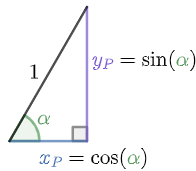
The point #P=\rv{\blue{x_P}, \purple{y_P}}# starts at #\rv{1,0}# and moves counterclockwise across the unit circle. The angle of rotation is called #\green{\alpha}#.
Therefore #\sin(\green{\alpha})=\purple{y_P}# and #\cos(\green{\alpha})=\blue{x_P}#.
In this way, we can also define angles greater than #90^\circ# using the sine and the cosine.
With this unit circle, we can now express the size of the angle in radians.
The size of angle #\green{\alpha}# in the unit circle in radians is the length of the arc on the unit circle.
The length of the entire arc is #2 \pi#. Therefore, an angle of #360^\circ# is equal to #2 \pi# radians.
An angle #\green{\alpha}# in degrees measures #\tfrac{\green{\alpha}}{180}\cdot\pi# radians.
The angle of #30# degrees measures #\tfrac{\green{30}}{180}\cdot\pi = \tfrac 16 \pi#.
An angle #\green{\alpha}# in radians measures #180\cdot \tfrac{\green{\alpha}}{\pi}# degrees.
The angle #\pi# radians measures #180 \cdot \tfrac{\green{\pi}}{\pi} = 180# degrees.
There are also angles greater than #360^\circ# or #2 \pi#. These angles are more than a full rotation on the unit circle. The length of the arc is then \[\text{length of arc}=2 \pi \cdot \text{number of full rotations}+\text{angle on unit circle}\]
The cosine and sine of angles of which we add a multiple of #2 \pi# are therefore equal. Therefore:
\[\begin{array}{c}\sin(\alpha+2 \pi)=\sin(\alpha)\\ \\ \cos(\alpha+2 \pi)=\cos(\alpha) \end{array}\]
The same applies to negative angles, only then we do full rotations backwards on the unit circle.
Examples
\[\begin{array}{rcl}\cos(\tfrac{5}{2}\pi)&=&\cos(\tfrac{1}{2}\pi+2 \pi)\\ &=&\cos(\tfrac{1}{2}\pi)\\ &=&0 \\ \\ \sin(\tfrac{7}{3}\pi)&=&\sin(\tfrac{1}{3}\pi+2 \pi) \\&=& \sin(\tfrac{1}{3}\pi)\\ &=&\tfrac{1}{2}\sqrt{3}\end{array}\]
When we work with angles in radians using our calculator, we have to set it to radians.
Note that when we do so, your calculator will often give answers as decimal numbers, while we usually work with exact values. In the section Special values of trigonometric functions, we'll have a look at the most important values.
The sine of an angle #\alpha#, in radians or in degrees, gives the #y#-coordinate of the point on the unit circle which has angle #\alpha# relative to the #x#-axis.
The cosine of an angle #\alpha#, in radians or in degrees, gives the #x#-coordinate of the point on the unit circle which has angle #\alpha# relative to the #x#-axis.
When we apply the Pythagorean theorem in the unit circle, we can define a very useful rule for angles.
For every angle #\green{\alpha}# in the unit circle, we have the right-angled triangle with legs #\sin(\green{\alpha})# and #\cos(\green{\alpha})#, and the hypotenuse with length #1#.
By the Pythagorean theorem, we now have
\[\sin(\green{\alpha})^2+\cos(\green{\alpha})^2=1\]
This equation is called the Pythagorean identity.
Example
\[\begin{array}{rcl}\sin(\green{60^\circ})^2+\cos(\green{60^\circ})^2&=& \\ \left(\purple{\dfrac{\sqrt{3}}{2}}\right)^2 + \left(\blue{\dfrac{1}{2}}\right)^2 &=&\\ \dfrac{3}{4}+\dfrac{1}{4}&=& 1 \end{array}\]
We have for every angle #\green{\alpha}#, measured in degrees or radians, the same rule \[\sin(\green{\alpha})^2+\cos(\green{\alpha})^2=1\]
It does not matter if we are calculating in degrees or in radians for the rule to hold. In the unit circle, we always have the right-angled triangle with legs #\purple{y_p}=\sin(\green{\alpha})# and #\blue{x_p}=\cos(\green{\alpha})#, and the hypotenuse with length #1#. Again, the rule follows using the Pythagorean theorem.
Examples
\[\begin{array}{rcl}\sin(\green{30^\circ})^2+\cos(\green{30^\circ})^2&=& \\ \left(\purple{\dfrac{1}{2}}\right)^2 + \left(\blue{\dfrac{\sqrt{3}}{2}}\right)^2 &=&\\ \dfrac{1}{4}+\dfrac{3}{4}&=& 1 \\ \\ \sin(\green{\frac{1}{6}\pi})^2+\cos(\green{\frac{1}{6}\pi})^2&=& \\ \left(\purple{\dfrac{1}{2}}\right)^2 + \left(\blue{\dfrac{\sqrt{3}}{2}}\right)^2 &=&\\ \dfrac{1}{4}+\dfrac{3}{4}&=& 1 \end{array}\]
The rule also applies to obtuse angles, negative angles, and angles larger than #360^{\circ}# or #2 \pi#.
Examples
#\sin(\green{135^\circ})^2+\cos(\green{135^\circ})^2 = \left(\purple{\frac{\sqrt{2}}{2}}\right)^2 + \left(\blue{-\frac{\sqrt{2}}{2}}\right)^2 = \dfrac{1}{2}+\dfrac{1}{2} = 1#
#\sin(\green{\frac{7}{3}\pi})^2+\cos(\green{\frac{7}{3}\pi})^2 = \sin(\green{\frac{1}{3}\pi})^2+\cos(\green{\frac{1}{3}\pi})^2 = \left(\purple{\frac{\sqrt{3}}{2}}\right)^2 + \left(\blue{\frac{1}{2}}\right)^2 = \dfrac{3}{4}+\dfrac{1}{4} = 1#
#\sin(\green{-\frac{5}{6}\pi})^2+\cos(\green{-\frac{5}{6}\pi})^2 = \sin(\green{\frac{7}{6}})^2+\cos(\green{\frac{7}{6}\pi})^2 = \left(\purple{-\frac{1}{2}}\right)^2 + \left(\blue{-\frac{\sqrt{3}}{2}}\right)^2 = \dfrac{1}{4}+\dfrac{3}{4} = 1#
The rule follows from the definition of the Pythagorean theorem.
For every angle #\green{\alpha}# in the unit circle, we can identify the right-angled triangle with legs #\purple{y_P}=\sin(\green{\alpha})# and #\blue{x_P}=\cos(\green{\alpha})#, and the hypotenuse with length #1#.
Applying the Pythagorean theorem, we have
\[\purple{y_P}^2+\blue{x_P}^2=1^2\]
Substituting the values for #\purple{y_P}# and #\blue{x_P}#, gives us the rule.
\[\sin(\green{\alpha})^2+\cos(\green{\alpha})^2=1\]
How many radians does an angle of #70# degrees measure?
Give your answer in the form of a decimal number with two decimal digits.
#1.22# radians
According to the theory, an angle of #\alpha# degrees measures exactly #\dfrac{\alpha\cdot\pi}{180}# radians.
To find the answer to the question, we enter #\alpha=70# into this expression:
\[
\dfrac{70\cdot \pi}{180}\approx 1.22\]


 Unit circle and angles in radians